
Elevating Personal Experience for Museum Visitors
Changing paradigms

Most people think of museum docents as the people who can explain a work of art to the inquiring visitor. They know the history of that piece, how it ties into a historical tradition of artistic references, and if you’re lucky, they might let you in on the lesser known “tea” of who the artist was sleeping with, drinking with, or how penniless they might have been at the time the work was created.
While that information can certainly enhance a visit to the museum, the paradigm of guiding visitors is changing, moving from the experience of meeting a “sage on the stage” to more of “a guide on the side.” The docent is less there to tell one what the work means and how it should be interpreted to becoming more of an interlocutor, asking probing questions, trying to draw out interpretations and reflections from the visitors themselves.
Every visitor brings something unique to the museum experience, their own personal history, associations, drama, favorite colors, life experiences, childhood pleasures and traumas, and more. Some people have varied life experiences – with knowledge of foreign languages, distant cultures, or years of training in institutions of higher education. Others might have never left their local community. How do we cultivate an experience which is relevant for all visitors, one that celebrates the diversity of experience that people bring to their own engagement with the museum and its collected objects?
I’ve dedicated many years developing educational materials designed to engage K-12 students. If you can’t find a hook to help a student relate what they are learning to their own lives, content is forgotten soon after it is introduced. Yet, if we can help students -- or museum visitors -- make connections to their own lives and experiences, they’ll be more likely to leave the exhibit with a lasting connection – a link to the ideas, feelings, and experiences that the objects have to offer. In other words, visitors should not be treated as passive observers, but rather active participants in the creation of their own meaning.
I recently toured LACMA with my eldest daughter, Eliana, and her musician husband, Zach Mayer. We explored an excellent exhibition of Chinese-related calligraphy titled Line, Form and Qi which explores a range of calligraphic interpretations from 20th and 21st century artists -- some of which are legible, many of which veer into abstraction. All the works carried meaning in different ways, whether as words on a canvas, as an abstract feeling, or simply an expression of Qi (energy or life force). One that caught our attention was Hsaio Chin’s elongated brush stroke.
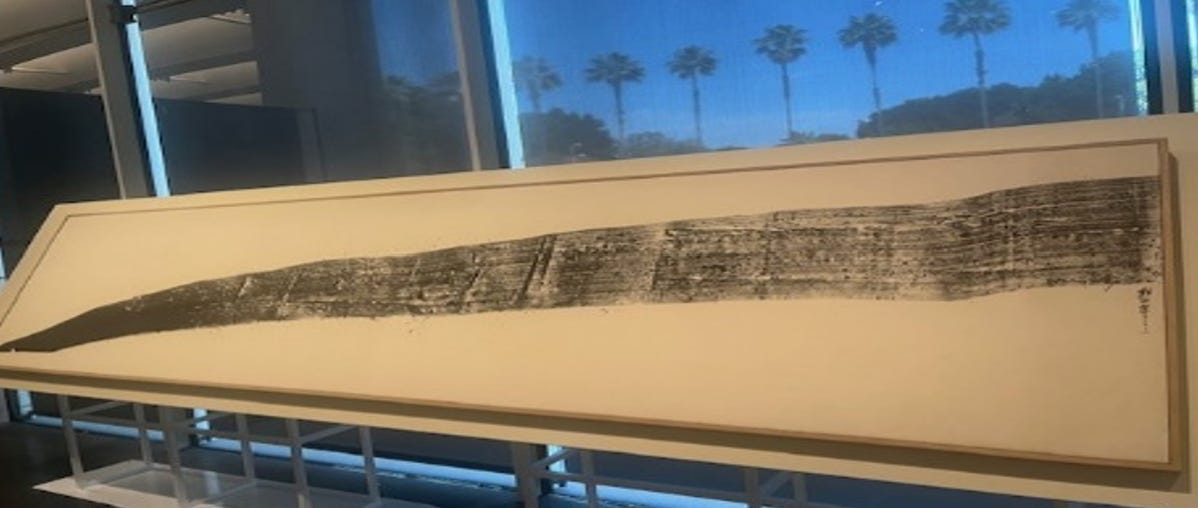
It originates in thick black ink in the lower left-side of the canvas and streaks across, up and away, thinning as it moves toward the top-right side. The ink dissipates as the brush moves along its upward trajectory. Visitors note the strong force of energy that the sustained brush stroke seems to represent. One can imagine the artist’s implement scraping with varied pressure as ink concentrates in lines and dots with the force of the artist’s movement. You can tangibly sense the act of creation. When one reads the title, set off to the side, the artist’s intention is seemingly revealed: Cometa 3. Suddenly one can’t help but see a dazzling celestial object flying powerfully across the night sky. But is that all there is to see?
When you move a bit closer and take in just a smaller section of the overall piece it looks like an orchestral score.
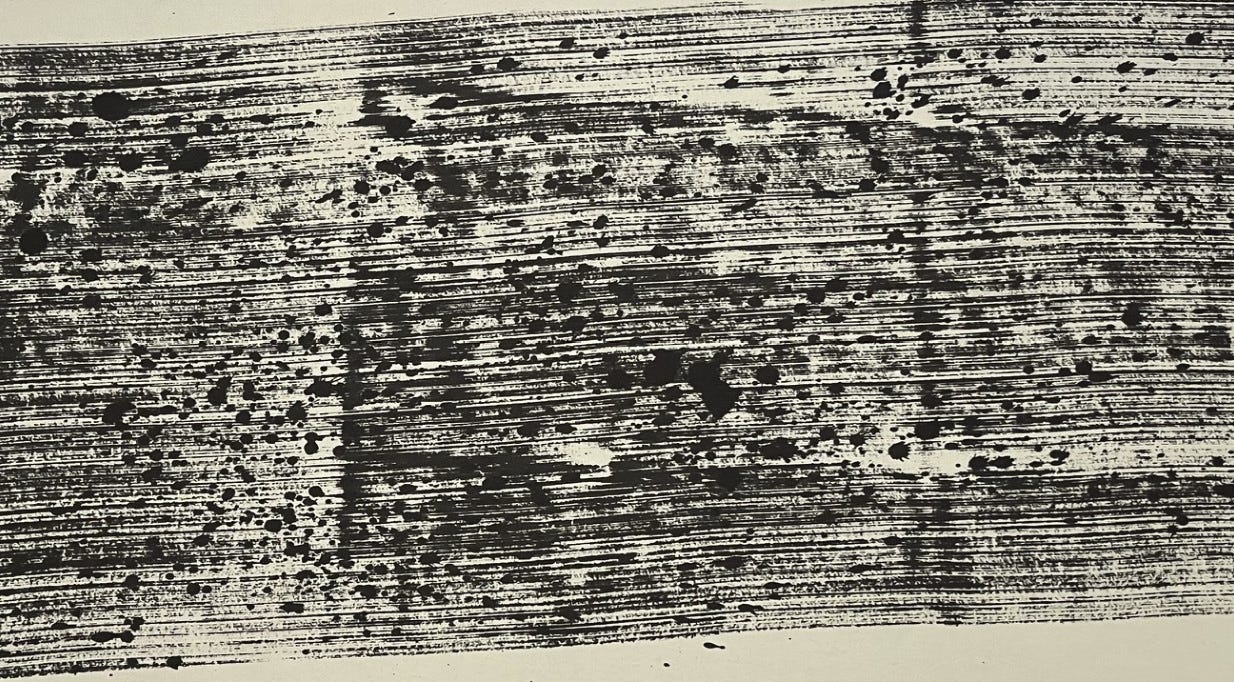
Can it be read as musical notation? If so, would everybody have access to this interpretation, or might it take specialized training and a unique body of background knowledge to draw this idiosyncratic meaning out from the piece? I could see how it might be interpreted as a score, but I couldn’t assess whether it could actually be read as one. But Zach, whose expertise is in musical improvisation, could…
This really hit the mark for me. We all bring something unique to our experience with objects in the museum. What that is and what it means may have little to do with the intentions of the artist or the knowledge of the docent leading your tour of the exhibit. As docents, we need to celebrate the power of interpretation and devise strategies to help guide our visitors to find themselves in the works. That is the kind of experience they will take home with them.
Can you think of an example of a time when you experienced a work of art in a way that was profoundly personal and may have had nothing to do with the artist’s intentions? Reflect and share in the comments below.
P.S. You can listen to Zach Mayer’s recent album, Zeh Ha’yom (This is The Day) online today.😉
So many of my artistic experiences have been facilitated through another’s storytelling, which at the time is entertaining, but I am tough tried to think of a moment when someone facilitated my own thoughts on the matter and how I relate to it. Hoping I can join a tour with you soon when the questions sound more like:
“How penniless does it look like the artist was when they made this piece?
Have you ever made art without a dime to your name?”
Thank you Aaron. Your piece is really interesting and offers an exciting perspective on what the museum experience can be. I look forward to visiting LACMA with you at my side 😘